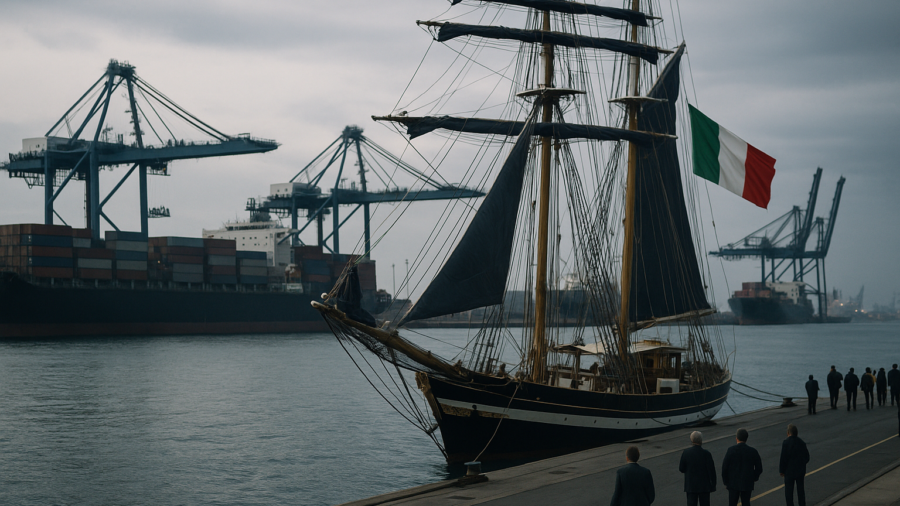
Italy’s premier wine trade platform is intensifying its push into the American market, with Veronafiere announcing that the third edition of Vinitaly.USA will take place in New York in conjunction with the Amerigo Vespucci World Tour’s North America Campaign in 2026. The event, detailed in a PRNewswire release, represents a deliberate attempt to embed Italian wine promotion within a broader exercise of cultural and soft-power diplomacy, leveraging the historic Italian naval vessel as a backdrop for commercial outreach.
The United States remains the single largest export destination for Italian wine by value, a market that Italian producers and trade bodies have worked systematically to cultivate over the past decade. Pairing a commercial wine event with the arrival of the Vespucci — a three-masted training ship of the Italian Navy that has become one of Rome’s most recognizable instruments of international goodwill — signals that Veronafiere views the American market not merely as a sales target but as a long-term strategic priority requiring sustained institutional investment.

New York as the Anchor for Italian Export Strategy
New York’s selection as the host city is far from incidental. The metropolitan area functions as the country’s primary port of entry for premium imported wines, both literally and commercially, with distributors, sommeliers, and on-trade buyers concentrated in a density found nowhere else in the United States. By staging Vinitaly.USA there for a third consecutive time, Veronafiere is reinforcing New York’s status as the de facto gateway through which Italian producers must pass to secure national distribution and build brand recognition among American consumers.
The format of Vinitaly.USA is designed to complement rather than replicate the flagship Vinitaly fair held annually in Verona, which typically attracts more than 4,000 exhibitors and draws over 93,000 visitors across four days. The New York edition operates on a more curated scale, targeting importers, retail buyers, press, and high-net-worth consumers who can translate exposure into purchasing decisions at a premium price point. Italian wine exports to the United States were valued at approximately 1.9 billion euros in recent full-year figures, underscoring the financial stakes attached to sustaining momentum in the market.
Trade Headwinds and the Tariff Question
The announcement arrives at a moment of considerable uncertainty for European food and beverage exporters operating in the American market. Renewed debate in Washington over tariff structures affecting imported goods — including wine — has introduced a layer of commercial risk that Italian producers and Veronafiere alike will need to navigate carefully in the lead-up to the 2026 event. The broader question of import price pressures on consumer goods has grown more acute in recent months, with retailers and distributors watching policy developments closely before committing to forward inventory decisions.

For Veronafiere, the calculus is nevertheless straightforward: the organizational cost of maintaining a permanent U.S. event presence is modest relative to the promotional value it generates for the hundreds of Italian wineries that rely on American sales to sustain export revenue. By anchoring the third edition to the Vespucci tour, the organizers also gain access to diplomatic and institutional networks — embassies, consulates, Italian-American business chambers — that can amplify reach well beyond what a standalone trade fair would achieve.
The 2026 edition will also take place against a backdrop of rising consumer interest in provenance and authenticity, trends that favor Italy’s diverse denominazione di origine controllata system, which offers buyers a regulated guarantee of regional character. Whether that structural advantage proves sufficient to offset any tariff-related price increases at the shelf level remains one of the more consequential open questions for Italian exporters heading into next year. Observers tracking income-driven consumption splits note that premium imported wine has historically proven more resilient among upper-income households, a demographic that Vinitaly.USA is explicitly designed to reach.