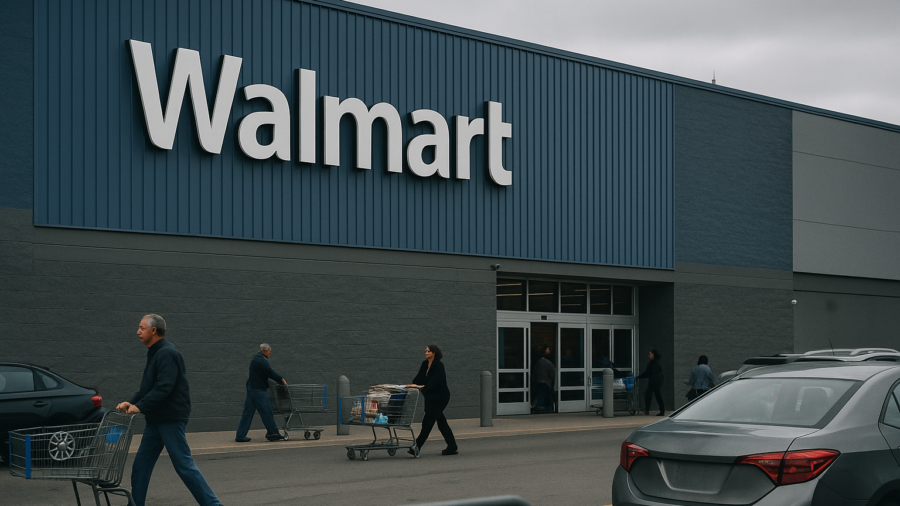
Walmart has moved to reduce prices on a range of consumer goods, a development President Donald Trump was swift to claim as a personal victory in his ongoing battle against inflation criticism. However, the retail giant stopped well short of crediting the president for the decision, creating a notable disconnect between the White House’s narrative and the company’s own public positioning, according to a Fortune report published Monday.
Trump, who has faced sustained political pressure over the cost of living since returning to office, took to social media to announce that Walmart had agreed to cut prices following direct communication with the company’s leadership. The president framed the move as evidence that his economic agenda, including tariff negotiations and deregulation, was producing tangible results for American consumers. White House aides echoed the claim, pointing to the Walmart development as a sign that corporate America was responding to presidential pressure to bring costs down.

Walmart’s Silence on Presidential Influence
For its part, Walmart offered no public acknowledgment that the president’s intervention played any role in the pricing adjustment. The company, which operates more than 4,600 stores across the United States and serves roughly 255 million customers each week globally, attributed the changes to supply chain efficiencies, supplier negotiations, and its ongoing commitment to offering competitive everyday low prices. No executive statement referenced a conversation with the White House or any governmental directive.
The retailer’s reticence is unlikely to be incidental. Walmart has long cultivated a carefully managed relationship with Washington across administrations of both parties, and publicly aligning its pricing strategy with any single political figure carries reputational risk in a deeply polarized market. Analysts noted that the price reductions, while real, appeared to be narrowly targeted and consistent with seasonal promotional activity rather than a broad structural rollback driven by external political forces.
Inflation Politics and the Broader Consumer Squeeze
The dispute over credit reflects a deeper tension in the current political economy. Consumer prices remain elevated across several key categories, including food at home, housing, and auto insurance, even as headline inflation figures have moderated from their 2022 peaks. The administration has struggled to translate those moderated readings into improved public sentiment, with polling consistently showing that a majority of Americans still believe the economy is performing poorly for households like their own.

The political stakes are significant. Trump has repeatedly invoked corporate cooperation as a substitute for traditional monetary or fiscal tools, pressuring retailers, manufacturers, and energy producers to hold or reduce prices without formal regulatory action. Critics argue the approach is structurally ineffective and amounts to performative economics, while supporters contend it demonstrates the administration’s willingness to use the bully pulpit aggressively in the consumer interest. The Walmart episode is unlikely to resolve that debate. Research on income divide pressures has shown that lower-earning households remain disproportionately exposed to price volatility in staple goods categories, precisely the segment Walmart’s customer base skews toward.
For investors, the episode carries secondary implications. Walmart’s shares have held firm amid broader market uncertainty, supported by its reputation for resilience during inflationary cycles. Yet sustained pressure from the White House to suppress pricing could theoretically compress margins if cost inputs from tariff-affected supply chains remain elevated. The company sources significant volumes of goods from Asia, and any renewed tariff escalation could force difficult trade-offs between political optics and shareholder returns. Forecasts for U.S. equity market performance in the second half of the year, as reflected in Nasdaq-100 predictions, remain cautiously positioned against a backdrop of unresolved trade and inflationary uncertainty.
Whether Walmart’s price reductions represent a genuine turning point in consumer affordability or a carefully managed public relations moment remains to be seen. What is clear is that the gap between the White House’s framing and the company’s own account has given both critics and supporters ample room to interpret the same set of facts in sharply different ways.