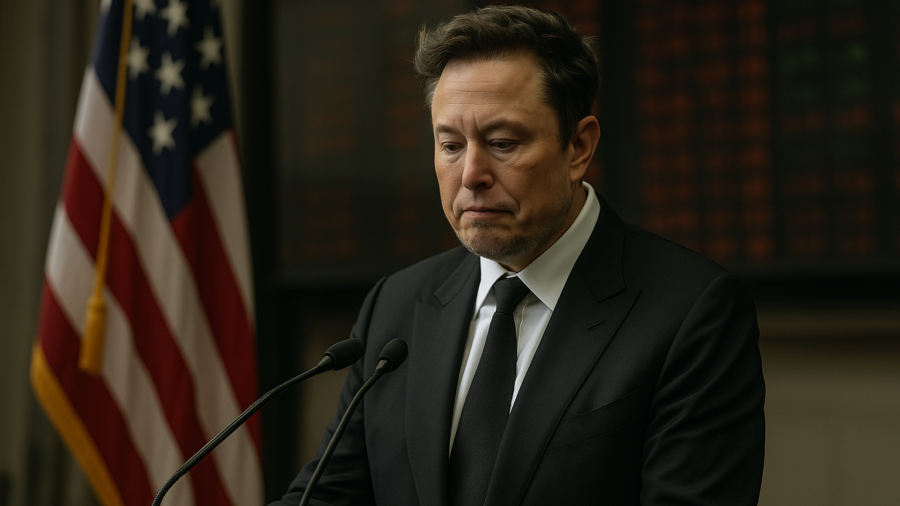
Elon Musk, the world’s wealthiest individual and chief executive of Tesla, SpaceX, and the social media platform X, has publicly acknowledged that some of his recent posts criticising former and current President Donald Trump went further than he intended, in what analysts are describing as a notable retreat from one of the most closely watched political and business feuds in recent memory. MarketWatch reported that Musk made the admission directly on X, the platform he acquired in a $44 billion deal in October 2022, stating that certain posts “went too far” and expressing personal regret over their tone and content.
The acknowledgement is unusual for Musk, who has rarely walked back public statements of any kind, and it arrives at a particularly sensitive moment for his business empire. Tesla shares have experienced significant volatility throughout 2025, at one point declining more than 30 percent from their post-election highs as investors weighed the consequences of Musk’s political entanglements on consumer sentiment and brand reputation across key markets in North America and Europe.

A Feud That Rattled Markets and Business Partners
The tensions between Musk and Trump escalated publicly over disagreements centred on fiscal policy, specifically over a large federal spending and tax legislation package that Musk vocally opposed, describing it at various points as irresponsible and damaging to the long-term fiscal health of the United States. Musk, who led the Department of Government Efficiency under the Trump administration before departing the advisory role earlier this year, used his platform on X to mount what some observers characterised as an unusually aggressive campaign against a sitting president from within his own political orbit.
The fallout extended beyond political commentary. Reports emerged of strained relationships between Musk’s companies and the federal government, with some analysts raising questions about the future of government contracts held by SpaceX, which relies on NASA and Department of Defense agreements that collectively represent billions of dollars in annual revenue. SpaceX’s valuation, last estimated at approximately $350 billion in private market transactions, could be materially affected if those relationships deteriorate in a sustained way, according to analysts familiar with the company’s contract structure.
The Business Case for De-escalation
Musk’s decision to publicly moderate his tone carries clear commercial logic. Tesla, his most prominent publicly traded company, has faced declining sales in several European markets where political backlash against Musk’s far-right commentary has been particularly acute. In Germany, Tesla deliveries fell sharply in the first quarter of 2025 compared with the prior year period, according to data published by the German Federal Motor Transport Authority. Restoring a working relationship with the Trump administration would also ease regulatory pressures on autonomous driving approvals and federal infrastructure funding relevant to SpaceX’s Starlink satellite internet business.
Investors appeared to respond cautiously but positively to signs of a potential thaw. Tesla shares edged higher in early trading following news of Musk’s concession, though broader market conditions and ongoing questions about the company’s near-term delivery targets continued to weigh on sentiment. Analysts at several major investment banks have maintained that the single largest overhang on Tesla’s valuation in 2025 has been uncertainty surrounding Musk’s political activities rather than any fundamental deterioration in the company’s technology or competitive positioning.

Implications for Musk’s Broader Empire
Beyond Tesla, the episode underscores the increasingly complex relationship between Musk’s personal brand and the constellation of companies he controls or influences. xAI, his artificial intelligence venture, continues to seek enterprise partnerships and data licensing agreements that could be complicated by reputational turbulence. The Grok large language model, positioned as a direct competitor to OpenAI’s ChatGPT and Google’s Gemini, requires broad commercial adoption to justify its rapid development costs, which include the redeployment of senior engineers from SpaceX programmes.
For markets, the Musk-Trump episode offers a pointed reminder of how political risk can transmit rapidly into equity valuations when a chief executive’s public persona becomes inseparable from the companies he leads. Whether Musk’s expression of regret marks a genuine recalibration of his public conduct or a tactical pause ahead of further confrontations remains to be seen. Readers following the intersection of Musk’s political and commercial activities may also wish to review our earlier coverage, which detailed how Tesla’s stock surged following a long-awaited Full Self-Driving software update that briefly restored investor confidence in the company’s autonomous vehicle roadmap.