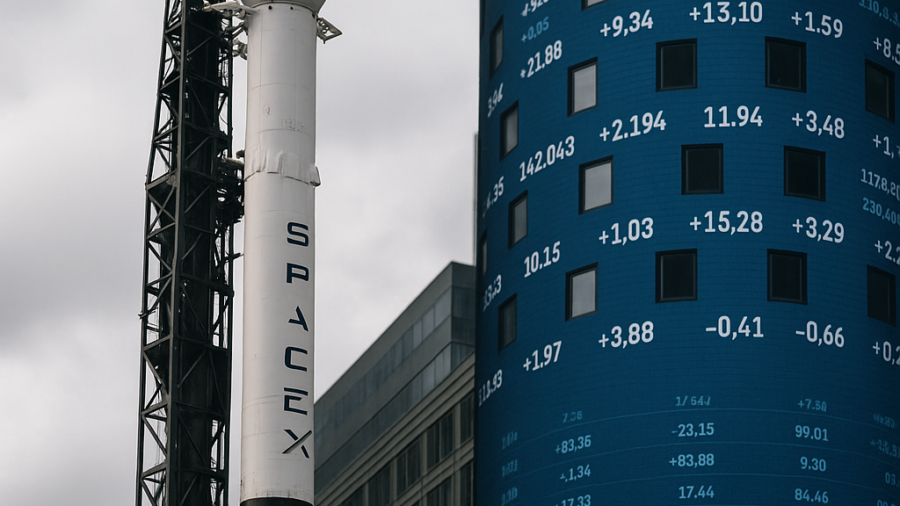
SpaceX, Elon Musk’s privately held aerospace and satellite company, is set to join the Nasdaq-100 index in a fast-tracked inclusion process that market analysts say will generate billions of dollars in forced buying from exchange-traded funds and institutional index trackers. CNBC reported the development on Thursday, marking one of the most significant index events of the year and a rare instance of a private company gaining access to a major benchmark typically reserved for publicly listed equities.
The inclusion is expected to be completed on an expedited timeline, bypassing the standard quarterly review cycle that governs most Nasdaq-100 rebalancing decisions. The index, which tracks the 100 largest non-financial companies listed on the Nasdaq exchange, has a combined market capitalisation of roughly $22 trillion. SpaceX’s most recent private valuation stood at approximately $350 billion, a figure that would place it among the upper tier of existing index constituents by weight, potentially displacing smaller members currently sitting near the bottom of the ranking.

The mechanics of the addition are expected to set off a significant wave of passive investment demand. The Invesco QQQ Trust, the largest ETF tracking the Nasdaq-100 with over $300 billion in assets under management, would be legally required to acquire SpaceX shares proportionate to the company’s index weight. Dozens of additional ETFs benchmarked to the index would face identical obligations, collectively representing hundreds of billions of dollars in assets. Analysts at several major brokerages estimated total forced buying demand could reach between $8 billion and $15 billion depending on the final weighting assigned to SpaceX.
The move raises immediate structural questions about how SpaceX shares will be made available to passive funds, given that the company has not pursued a traditional initial public offering. One mechanism under discussion involves a special share class or a secondary market structure that would allow index funds to acquire exposure without a full public listing. Market observers noted that precedent for such arrangements is limited, and regulatory clarity from the Securities and Exchange Commission would likely be required before the inclusion becomes fully operational. Those watching for broader signals on private market integration into public indices may also want to consider our earlier coverage of crossing thresholds in alternative asset classes and the systemic questions they raise.

The announcement arrives at a moment of heightened scrutiny over equity valuations. Jeremy Grantham recently argued that U.S. markets are currently the most expensive in American history, a backdrop that lends added complexity to any event capable of mechanically redirecting tens of billions of dollars into a single company. SpaceX’s inclusion could simultaneously inflate benchmark indices and compress the weightings of dozens of existing constituents, creating secondary ripple effects across portfolios that track the Nasdaq-100 as a core holding.
Market participants will be watching closely for the official effective date and weighting methodology, both of which Nasdaq has yet to formally disclose. Trading in SpaceX-linked instruments on secondary private markets surged following the initial reports, with some platforms quoting implied valuations north of $370 billion. Whether the index addition ultimately accelerates a full public listing for SpaceX remains an open question, though several analysts suggested the company’s founder has little near-term incentive to pursue a conventional IPO given the access to capital and valuation recognition the index inclusion alone is expected to provide.