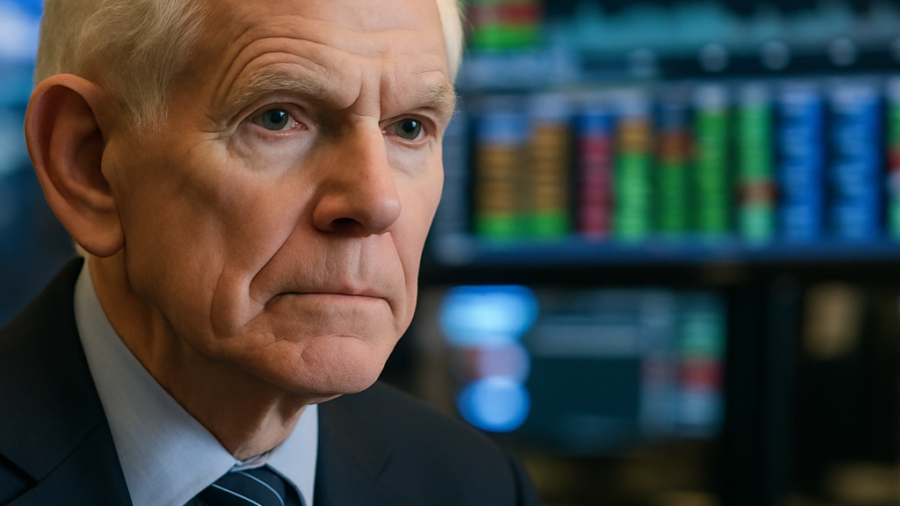
Jeremy Grantham, the co-founder of Boston-based asset manager GMO and one of Wall Street’s most closely watched long-term investors, has issued a stark warning that U.S. equities are now trading at the most elevated valuations in American financial history — eclipsing even the frothy peaks of 1929 and the dot-com bubble of 2000. CNBC reported on Grantham’s assessment, which was outlined in his latest investor letter under the headline “Jeremy Grantham says this is the most expensive market in ‘American history.'”
Grantham, who has built a reputation over five decades for identifying speculative bubbles before they burst, argued that current price-to-earnings ratios, price-to-sales multiples, and cyclically adjusted earnings metrics have converged at levels that collectively surpass any prior episode of market excess. He cited the S&P 500’s Shiller CAPE ratio — which smooths earnings over a ten-year period to reduce cyclical distortions — as sitting above 38, a level that has historically preceded prolonged periods of below-average returns. By comparison, the CAPE ratio stood at approximately 33 at the peak of the dot-com bubble in March 2000 and around 30 before the 1929 crash.
The veteran investor attributed the extreme valuations to a combination of factors, including persistent artificial intelligence enthusiasm driving mega-cap technology stocks to stratospheric multiples, years of ultra-loose monetary policy that inflated asset prices well beyond their fundamental anchors, and a structural shift in retail participation that has amplified momentum-driven buying. Grantham estimated that U.S. equities could face a mean-reversion drawdown of between 50 and 60 percent to return to historically normal valuation levels, a prospect he acknowledged could unfold over several years rather than in a single sharp correction.
His warning lands at a sensitive moment for investor sentiment. The U.S. stock market has already recorded its first outflow since March, raising concerns among portfolio strategists that institutional allocators are quietly repositioning ahead of what could be a turbulent second half of the year. The timing of Grantham’s remarks may accelerate that reassessment among risk-conscious fund managers.

Grantham was equally pointed in his critique of passive index investing, arguing that the dominance of index funds has concentrated capital in the most overvalued names, creating a self-reinforcing feedback loop that distorts price discovery. He singled out the top ten constituents of the S&P 500 as trading at an average forward price-to-earnings ratio well in excess of 30, levels he described as pricing in a decade of near-flawless execution with no allowance for macro disruption, competitive erosion, or regulatory headwinds.
For income-focused investors already questioning the durability of traditional portfolio construction, the warning compounds existing anxieties. The sustained rate environment has been straining the classic 60/40 portfolio, pushing advisors toward alternative allocations in search of uncorrelated returns. Grantham suggested that non-U.S. equities, particularly in emerging markets and value-oriented developed markets, offer significantly more attractive long-term entry points relative to their domestic counterparts. He did not specify a precise timeline for a correction, reiterating that bubbles can persist far longer than rational analysis suggests — but that the eventual reversion, when it arrives, tends to be swift and severe.