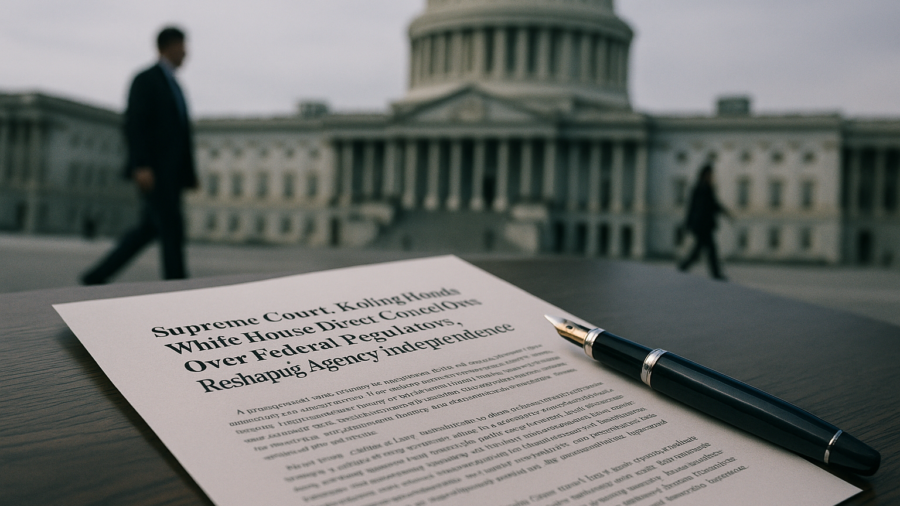
A sweeping Supreme Court decision issued in late June 2026 has fundamentally altered the constitutional architecture of the United States federal government, granting the executive branch direct authority to dismiss commissioners and leadership figures at agencies that have long operated at arm’s length from political control. The ruling, widely regarded as one of the most consequential decisions on executive power in a generation, effectively ends the long-standing legal doctrine that shielded regulators at bodies such as the Federal Trade Commission and the Federal Reserve from arbitrary presidential removal.
The decision arrives at a moment of acute sensitivity for financial markets, where the perceived independence of federal regulators has long served as a stabilising signal for both domestic and international investors. Legal scholars estimate that more than a dozen major agencies — collectively overseeing trillions of dollars in economic activity — could now be subject to greater presidential influence over personnel and, by extension, policy direction.
The FTC Decision and Its Immediate Fallout
The proximate trigger for the ruling was a challenge involving the Federal Trade Commission. As The Verge reported, the Supreme Court explicitly allowed the firing of FTC commissioners, marking a decisive end to the agency independence protections that had been in place since the New Deal era. The FTC oversees competition enforcement and consumer protection across a broad swath of the American economy, with an annual budget exceeding $430 million and jurisdiction over matters ranging from pharmaceutical mergers to data privacy.
The immediate practical consequence is that commissioners at independent agencies can no longer rely on statutory protections that previously required a president to demonstrate cause before removing them. Critics warn this creates a chilling effect on regulatory decision-making, with officials potentially moderating enforcement actions to align with White House priorities. Supporters of the ruling argue it restores democratic accountability by ensuring that voters can hold the executive responsible for regulatory outcomes that affect daily economic life.
Marketplace, in its reporting on the ruling titled “The president’s new power over independent agencies,” noted that legal and economic observers are already assessing how the decision could reverberate through sectors including telecommunications, energy, and financial services — all of which depend on regulators whose credibility rests in part on their insulation from short-term political pressure.

Market and Economic Implications
For investors and corporations, the ruling introduces a new layer of political risk into the calculus of long-term planning. Regulated industries from banking to broadband have historically priced in a degree of regulatory predictability premised on agency independence. That premium is now in question. Bond markets, which are acutely sensitive to signals about the Federal Reserve’s autonomy, registered modest volatility in the days following the decision, with yields on 10-year Treasuries briefly spiking before settling.
The Federal Reserve’s status under the new legal framework remains a matter of active debate among constitutional lawyers. While the central bank’s structure differs from that of the FTC, analysts warn the ruling opens a conceptual door that could eventually be tested in litigation targeting the Fed’s personnel protections. Any erosion of perceived central bank independence would carry significant consequences for inflation expectations and the dollar’s reserve currency standing — concerns that have already surfaced in discussions around broader consumer confidence and macroeconomic uncertainty.
A Broader Shift in Executive Authority
The FTC ruling does not stand in isolation. It is part of a broader pattern of executive consolidation that has unfolded across multiple policy domains in 2026. In parallel, the administration has pursued aggressive fiscal measures, including a proposed $100,000 fee on H-1B visa holders that legal experts have characterised as functionally a tax instrument, as detailed in Forbes coverage of that dispute. Together, these moves sketch the outline of an executive branch operating with considerably fewer institutional checks than at any point in recent memory.
Constitutional scholars are divided on whether the ruling represents a pragmatic restoration of accountability or a dangerous concentration of power. What is not in dispute is the scale of its implications. Regulatory agencies that collectively employ tens of thousands of staff and issue rules affecting virtually every sector of the American economy now operate under a fundamentally different legal environment. For corporate strategists, compliance officers, and investors alike, recalibrating for a world in which regulatory leadership can shift with each election cycle will be among the defining planning challenges of the coming years. Readers tracking related shifts in investor sentiment may also find relevant context in recent analysis of investor return expectations against a backdrop of heightened policy uncertainty.