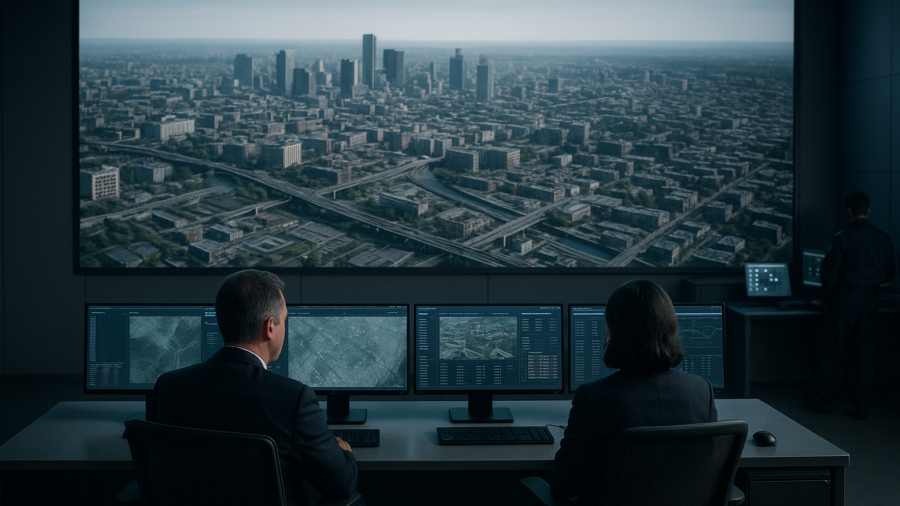
Rafael Advanced Defense Systems, the Israeli state-owned company behind the Iron Dome interceptor and the Iron Beam laser defense system, is extending its battlefield simulation capabilities beyond military installations and into full urban environments. According to a Calcalist Tech report, the company is now deploying a comprehensive simulation platform capable of modeling an entire city’s infrastructure, emergency response systems, and threat scenarios in a single integrated environment.
The move marks a significant expansion of Rafael’s commercial and dual-use technology portfolio at a time when defense contractors globally are seeking to diversify revenue streams. Rafael, which reported revenues exceeding $3 billion in recent years, has long supplied systems to dozens of countries, but the push into city-scale simulation represents a new frontier in applying defense-grade digital modeling to civilian planning and security preparedness.

From Missile Defense to Metropolitan Modeling
The simulation technology Rafael is bringing to urban environments draws directly on the same synthetic environment and threat-modeling tools developed for military exercises, where commanders must rehearse complex, multi-variable scenarios before committing assets in the field. The company’s defense simulation division has spent decades refining these systems for air defense coordination, ground force maneuvering, and multi-domain operations. Adapting that architecture to a city means integrating data streams from traffic systems, utility grids, communications networks, and emergency services into a unified operational picture.
Industry analysts note that the market for urban resilience and emergency management simulation is growing rapidly, driven by increased investment in homeland security infrastructure across Europe, Asia, and the Gulf states. Governments are increasingly treating large-scale crisis preparedness — whether from natural disaster, cyber attack, or armed threat — as a core planning function rather than an afterthought, creating a commercial opening for companies with proven simulation pedigree. Rafael’s established relationships with defense ministries in more than 35 countries give it a procurement channel that purely civilian simulation vendors cannot easily replicate.
Commercial Implications and Strategic Positioning
The city-scale simulation platform is being positioned as a tool for municipal governments, national emergency agencies, and critical infrastructure operators. Potential clients could use the system to run live-fire equivalent drills in a virtual environment — stress-testing a city’s response to a simultaneous power grid failure and mass-casualty event, for example, without the logistical cost or public disruption of a physical exercise. The economic case for this kind of investment is increasingly straightforward: the Federal Emergency Management Agency in the United States alone has estimated that every dollar spent on pre-disaster preparedness saves approximately six dollars in post-event recovery costs, a ratio that resonates with budget-conscious municipal planners worldwide.

For Rafael, the diversification into dual-use simulation aligns with a broader trend among Israeli defense technology companies seeking civilian and export revenue as domestic defense budgets face competing pressures. The country’s defense-tech ecosystem has long punched above its weight commercially, with firms like Elbit Systems and IAI generating substantial international sales alongside their domestic contracts. Rafael’s entry into city-scale simulation adds another commercial dimension to a company whose profile has risen sharply in recent years as Iron Dome intercept footage circulated globally. Readers following the broader economic context of Israel’s defense-industrial base may find additional perspective in The Fiscalist’s earlier coverage of Israel’s war economy, which examines how sustained security spending interacts with civilian financial conditions.
The technology also sits at an intersection increasingly scrutinized by investors: artificial intelligence-driven simulation and digital twin modeling, sectors attracting significant venture and sovereign capital. Whether Rafael pursues a standalone commercial entity, a joint venture, or a licensing arrangement for the platform remains unclear from current disclosures, but the strategic logic of monetizing proprietary simulation infrastructure outside traditional defense procurement is well established. As governments and cities allocate more capital to resilience planning, companies with credible, battle-tested simulation tools are likely to find a receptive market. For broader context on how organizations are navigating AI-driven technology investments, The Fiscalist’s analysis of AI budget challenges offers relevant framing on the institutional barriers that can slow even well-funded deployments.