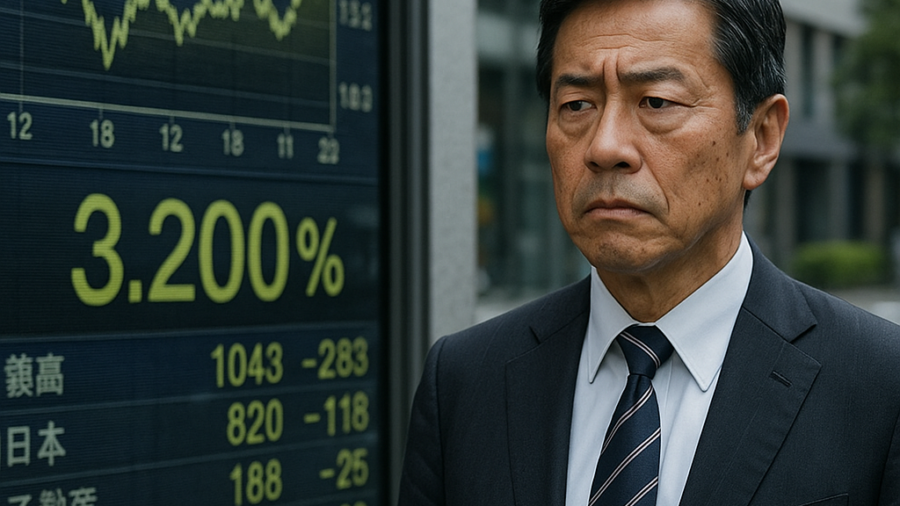
Japan’s 30-year government bond yield surged to a historic 3.2% on Wednesday, breaching levels not seen since the instruments were first issued and sending a stark signal that sovereign debt markets are losing confidence in Tokyo’s ability to manage its fiscal trajectory alongside a gradual monetary policy normalization.
The move, which extended a weeks-long selloff in super-long Japanese government bonds, came despite the Bank of Japan maintaining a cautious posture on further rate increases. The BOJ raised its benchmark rate to 0.5% in January — its highest in seventeen years — but policymakers have since signaled that additional hikes would be data-dependent and unhurried, a stance markets appear increasingly unwilling to reward with stability at the long end of the curve.

Analysts note that the selloff reflects a deepening anxiety about Japan’s fiscal arithmetic. The country’s public debt stands at roughly 260% of gross domestic product, and government projections released in May indicated that primary balance targets would be missed by wider margins than previously forecast. Defense spending commitments, set to reach 2% of GDP by 2027, and expanded social security obligations are crowding out any credible consolidation narrative. Bloomberg also noted that life insurers and pension funds — traditionally the bedrock buyers of super-long JGBs — have been reducing duration exposure, removing a structural support that kept yields anchored for years.
The 10-year JGB yield also climbed, reaching 1.58% intraday before settling around 1.54%, while the 20-year yield pushed above 2.6%. Currency markets took notice: the yen weakened past 157 per dollar as investors weighed whether the yield spike would force a more aggressive BOJ response or simply reflect a lasting repricing of Japan’s risk premium. Equity markets fell in tandem, with the Nikkei 225 dropping 1.4% on the session as financials and rate-sensitive real estate stocks absorbed the brunt of the adjustment.

For global fixed income investors, the development carries implications beyond Tokyo. Japan is the world’s largest holder of U.S. Treasuries, and a sustained rise in domestic yields could prompt Japanese institutions to repatriate capital, adding pressure to already unsettled Western bond markets. Minneapolis Fed President Neel Kashkari, who recently flagged the possibility of a U.S. rate increase as late as 2026, acknowledged last week that cross-border capital flows tied to Japanese yield dynamics remained a variable worth monitoring closely.
BOJ Governor Kazuo Ueda is expected to address the bond market turbulence at a press conference Thursday. Markets will be listening for any language suggesting an acceleration of the tightening timeline or, alternatively, any hint of yield curve intervention — a tool the central bank formally abandoned in late 2024 but has never entirely ruled out. Either message carries significant consequences. A faster hike path risks choking a still-fragile domestic recovery; a return to curve control risks further eroding the BOJ’s credibility at a moment when fiscal discipline is already under intense scrutiny.
Strategists at several major Tokyo-based brokerages warn that without a credible medium-term fiscal consolidation plan from the government, bond yields could test 3.5% on the 30-year before year-end, a threshold that would translate into materially higher borrowing costs across the Japanese economy and put additional strain on a government already managing record debt servicing expenses.