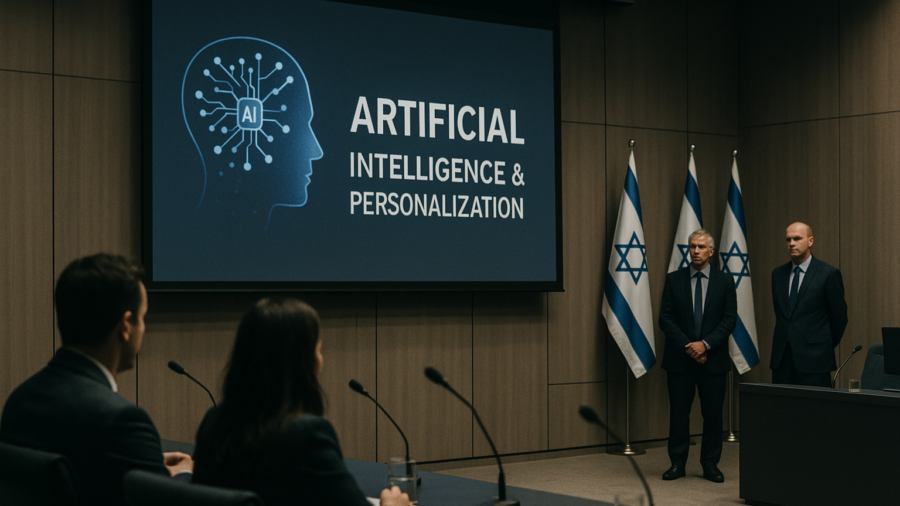
Some of Israel’s most prominent technology executives are forecasting a fundamental restructuring of global education, arguing that artificial intelligence and adaptive learning platforms will render the standardized classroom model effectively obsolete within a generation. Their predictions, gathered by Calcalist Tech, paint a picture of an industry on the cusp of its most disruptive transformation since the introduction of the personal computer.
The executives, drawn from across Israel’s technology sector, converged on a shared thesis: that AI’s capacity for real-time personalization will expose the structural inefficiency of delivering identical instruction to students with vastly different learning speeds, styles, and knowledge gaps. “We are nearing the end of the traditional, one-size-fits-all classroom,” one executive was quoted as saying, a sentiment echoed by several peers across different subsectors of the Israeli tech ecosystem.

Personalization at Scale: The Central Thesis
The executives outlined a future in which AI systems continuously assess individual student comprehension, dynamically adjusting curriculum pacing, content format, and difficulty level in real time. Rather than replacing teachers outright, they argued, technology would free educators from administrative and instructional repetition, repositioning them as mentors and facilitators. This distinction is commercially significant: it implies a market not for teacher-replacement software but for teacher-augmentation platforms, a framing that reduces regulatory and institutional resistance.
Israel’s edtech sector has quietly expanded in recent years, benefiting from the country’s deep engineering talent base and a domestic education system that has historically been receptive to technology adoption. While precise market-share figures for Israeli edtech were not disclosed in the executives’ remarks, the global edtech market is broadly projected to surpass $400 billion by the end of the decade, according to widely cited industry estimates, with AI-driven personalization tools representing one of its fastest-growing subsegments. Israeli firms competing in this space stand to capture a meaningful share if domestic innovation translates into exportable product.

Infrastructure, Investment, and the Road to Adoption
Several executives highlighted that the bottleneck to adoption is not technological readiness but institutional inertia. Ministries of education and school districts in most markets operate on multi-year procurement cycles, unionized workforces with defined contractual roles, and legacy infrastructure poorly suited to cloud-delivered AI applications. Breaking through these structural barriers, the executives noted, will require edtech companies to demonstrate measurable learning outcome improvements rather than relying on novelty or cost-efficiency arguments alone.
The investment case for AI-driven education aligns with a broader pattern observed across industries. As discussed in AI adoption warnings from enterprise technology leaders including Microsoft chief executive Satya Nadella, organizations that delay integrating AI risk falling irreversibly behind competitors that do not. In education, that competitive pressure translates to national and institutional performance gaps rather than market-share losses, raising the policy stakes considerably.
Israeli technology’s ability to operate and scale in complex, high-friction environments has historically been a competitive advantage in enterprise markets. Edtech, with its layered stakeholder map of governments, teachers’ unions, parents, and students, fits that profile closely. Several executives indicated their companies are already in advanced discussions with school systems in Europe and Southeast Asia, regions where central government procurement models may offer a more direct sales pathway than the fragmented district-by-district approach typical in the United States.
The broader economic context also matters. As explored in coverage of Israel’s war economy, domestic fiscal pressures have intensified scrutiny of public spending, including education budgets. That environment may paradoxically accelerate technology adoption if AI tools can credibly demonstrate cost savings alongside improved outcomes, giving budget-constrained administrators a dual justification for procurement. The executives who spoke to Calcalist Tech were careful to frame their predictions as near-to-medium term rather than imminent, but the directional consensus was clear: the architecture of formal education is entering a period of structural change, and Israeli technology companies intend to be central to shaping it.