
China is quietly reinforcing one of its most enduring economic institutions — a sprawling network of rural supply and marketing cooperatives that dates back to the early decades of the People’s Republic — as Beijing seeks to insulate its food supply chains from the shocks of an increasingly fractured global trade order. The move reflects a broader strategic calculation: that commercial infrastructure originally designed for a planned economy may now serve as a critical buffer against modern disruptions, from geopolitical tensions to extreme weather events. Analysts tracking Washington’s trade pressure on Beijing say the timing is unlikely to be coincidental.
According to reporting by Channel NewsAsia, the All-China Federation of Supply and Marketing Cooperatives — the apex body overseeing this system — operates through a network that reaches into virtually every rural county in the country, with total assets and annual transaction volumes running into the trillions of yuan. The federation serves roughly 900 million rural residents and functions as a hybrid between a state-linked trading body and a community-level logistics operator, handling everything from agricultural inputs such as seeds and fertilisers to the procurement and distribution of staple goods.
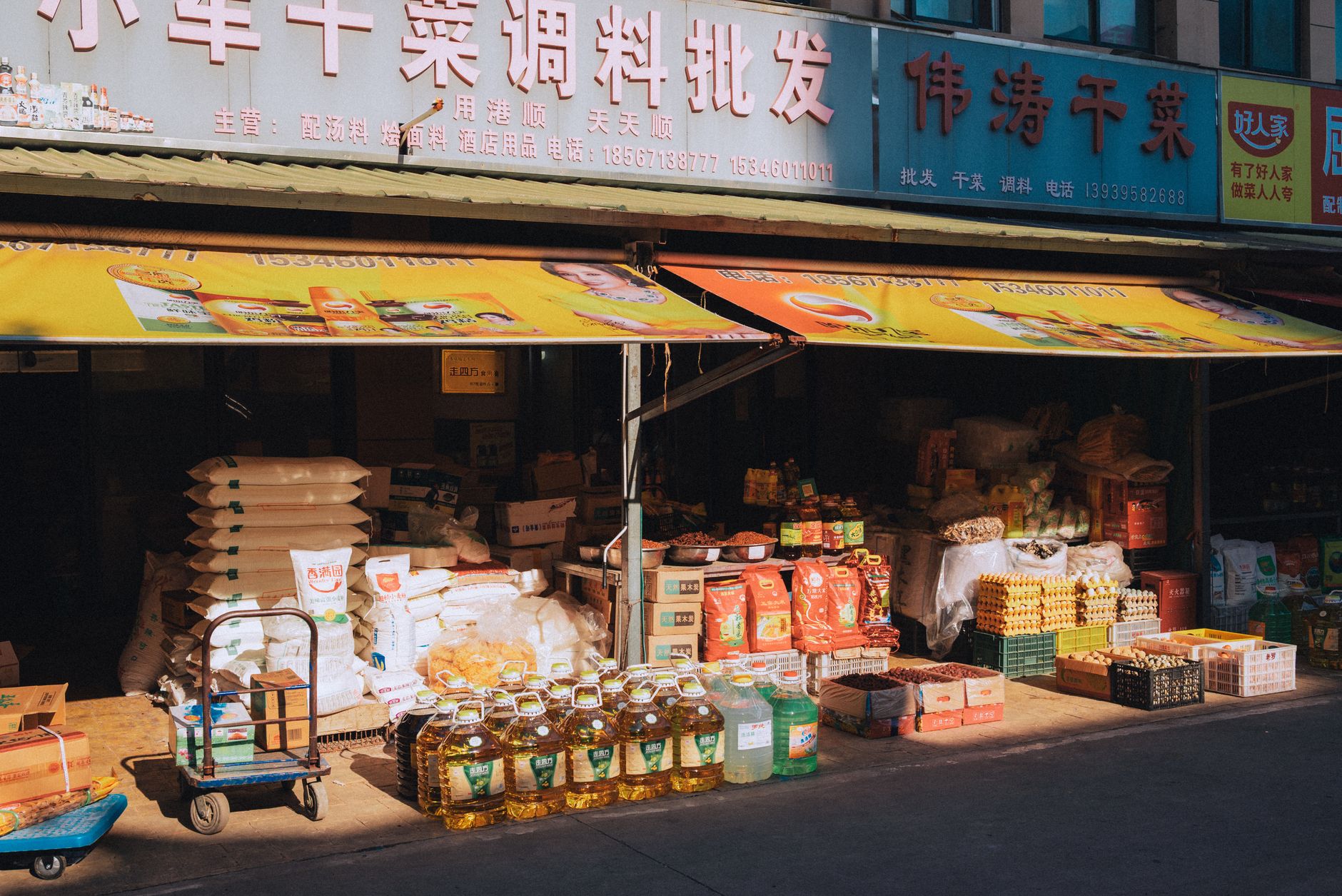
Structural Role in Agricultural Supply Chains
The cooperative network’s renewed prominence comes as China’s leadership places food security at the centre of its long-term economic planning. Beijing has repeatedly flagged vulnerability in its agricultural supply chain — particularly dependence on imported soybeans, potash-based fertilisers, and certain grain varieties — as a national risk factor. The supply and marketing cooperatives, which in some provinces control cold-storage facilities, seed banks, and last-mile delivery infrastructure, are being repositioned not merely as retail outlets but as logistical nodes in a nationally coordinated food resilience framework.
Local governments across several provinces have reportedly received directives to expand cooperative membership among smallholder farmers, who still account for the majority of China’s arable land under cultivation. By integrating these fragmented producers into the cooperative system, planners aim to improve the state’s visibility over domestic output and create more predictable procurement channels during periods of external supply stress. The strategy echoes elements of wartime supply management doctrine adapted for a peacetime but increasingly competitive global environment.
Economic Significance and Investment Implications
The scale of the cooperative system makes it a meaningful, if underappreciated, component of China’s domestic economy. Industry figures suggest the federation’s affiliated entities collectively employ millions of workers and contribute substantially to rural consumption — a segment the government has prioritised as a driver of internal demand amid slowing export growth. Strengthening this infrastructure also aligns with Beijing’s dual-circulation strategy, which seeks to reduce reliance on external markets by deepening domestic economic linkages.

For international investors monitoring China’s agricultural and consumer sectors, the policy signals a continued preference for state-adjacent commercial structures over fully privatised alternatives in strategically sensitive supply chains. Companies operating in adjacent markets — including foreign agribusiness firms, fertiliser exporters, and logistics providers — may find that cooperative channels become the dominant route to rural end-markets, requiring partnership or integration with the federation’s network to maintain access. The development also carries implications for commodity pricing, as a more centralised Chinese procurement mechanism could alter the timing and volume of China’s purchases on global grain and oilseed markets.
Economists caution that the cooperative model carries its own inefficiencies. Governance concerns, legacy debt at some provincial affiliates, and the challenge of modernising ageing physical infrastructure all present headwinds. Yet Beijing appears willing to absorb those costs in exchange for a degree of supply chain control that purely market-driven systems cannot easily guarantee. In an era defined by disruption — whether from tariffs, climate volatility, or pandemic-era logistics failures — the political calculus increasingly favours redundancy and state oversight over pure efficiency.