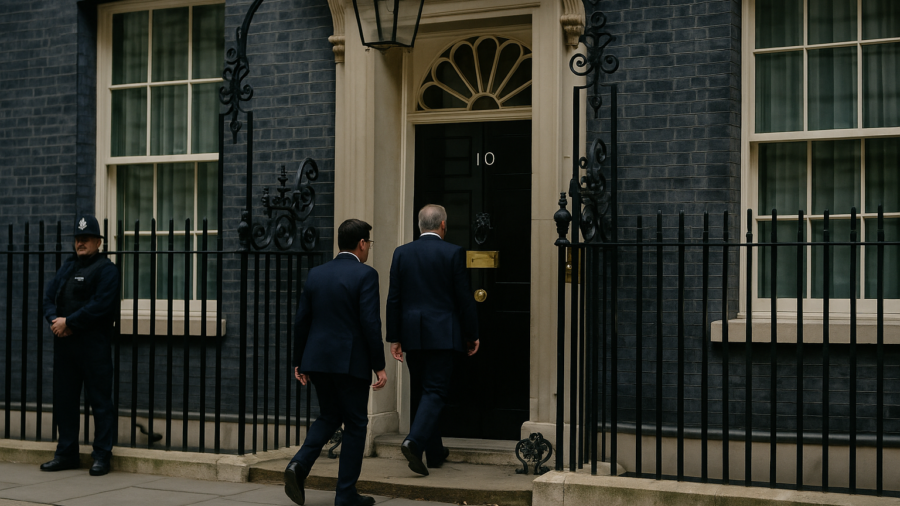
Keir Starmer has resigned as United Kingdom prime minister, ending a tenure marked by persistent approval-rating weakness and internal Labour Party friction, and paving the way for Greater Manchester Mayor Andy Burnham to assume the country’s top office. The development, first reported by NPR News on July 19, 2026, represents one of the most consequential shifts in British political leadership in more than a decade, with immediate implications for fiscal policy, public spending, and the United Kingdom’s standing in global markets. Investors tracking British gilt yields and sterling’s performance against the dollar and euro have been closely monitoring the Labour succession drama for weeks, conscious that a change at the top carries material policy risk during an already fragile period for the UK economy. For context on how geopolitical leadership transitions can rattle markets far beyond their immediate borders, The Fiscalist’s earlier coverage of US counterterrorism costs illustrates how political instability can rapidly translate into financial volatility.

Burnham, 56, confirmed his intention to step into the role via a public statement on X, in which he outlined his readiness to lead the country and signalled a shift toward a more regionally focused economic agenda rooted in his years governing Greater Manchester.
Starmer’s Economic Record and the Pressures That Forced His Hand
Starmer’s resignation caps a period of significant turbulence for the British economy. Inflation, while retreating from its post-pandemic highs, remained stubbornly above the Bank of England’s 2 percent target through much of his administration, and public sector borrowing continued to exceed Treasury forecasts in multiple consecutive quarters. His government’s handling of a cost-of-living crisis that squeezed household real incomes by an estimated 3.1 percent over two years drew sustained criticism from both opposition benches and dissatisfied Labour backbenchers who felt the administration’s fiscal conservatism left little room for meaningful redistribution. Approval ratings for Starmer personally fell to the low thirties in YouGov tracking polls conducted earlier this year, a level that made his long-term political survival increasingly difficult to defend to senior party figures.
The prime minister’s decision to resign rather than face a formal confidence vote reflects a calculation that an orderly transition would be less damaging to Labour’s electoral prospects than a prolonged internal battle. Senior party figures had reportedly held a series of private meetings with Starmer over recent weeks, urging him to consider the party’s position ahead of any potential by-election cycle. The pound’s brief dip on the news underscored the degree to which currency and bond markets remain sensitive to UK political signals at a time when the country’s debt-to-GDP ratio sits near its highest peacetime level in decades.
What a Burnham Premiership Could Mean for UK Policy and Markets
Burnham’s ascent brings with it a distinct policy profile shaped by his decade-long tenure running Greater Manchester’s combined authority. He has been a vocal advocate for devolved transport funding, integrated public health models, and what he has termed a “levelling up” economic strategy that prioritises post-industrial regions over London-centric growth. Analysts at several major investment banks were quick to flag that his priorities could translate into greater public capital expenditure directed toward northern England’s infrastructure, potentially widening the near-term fiscal deficit but offering productivity gains over a longer horizon. Bond markets will be watching the Office for Budget Responsibility’s next assessment closely for any revision to borrowing projections.

Business groups reacted with cautious optimism, noting that Burnham’s record in Greater Manchester demonstrated a pragmatic willingness to work with private sector partners on large-scale urban development projects. However, trade bodies representing financial services firms in the City of London expressed measured concern about potential shifts in regulatory philosophy and taxation policy, particularly given signals from Burnham’s inner circle that wealth distribution will feature more prominently in any forthcoming Budget statement. Global market participants, already navigating elevated geopolitical uncertainty as highlighted in Fortune’s recent analysis of Street risk sentiment around Middle East tensions, now have a fresh layer of UK political risk to price. Meanwhile, domestic pension funds and asset managers with significant gilts exposure will be seeking clarity from the new prime minister on borrowing limits and spending rules in the weeks ahead. Burnham is expected to address Parliament within days of formally taking office, with financial markets and policy watchers across Europe treating the statement as a critical early signal of his government’s economic direction. As tracked previously on The Fiscalist, retirement savings rules and broader household financial security remain a live concern in comparable Western economies, and Burnham’s social policy instincts suggest pension adequacy could become a priority agenda item in Britain as well.