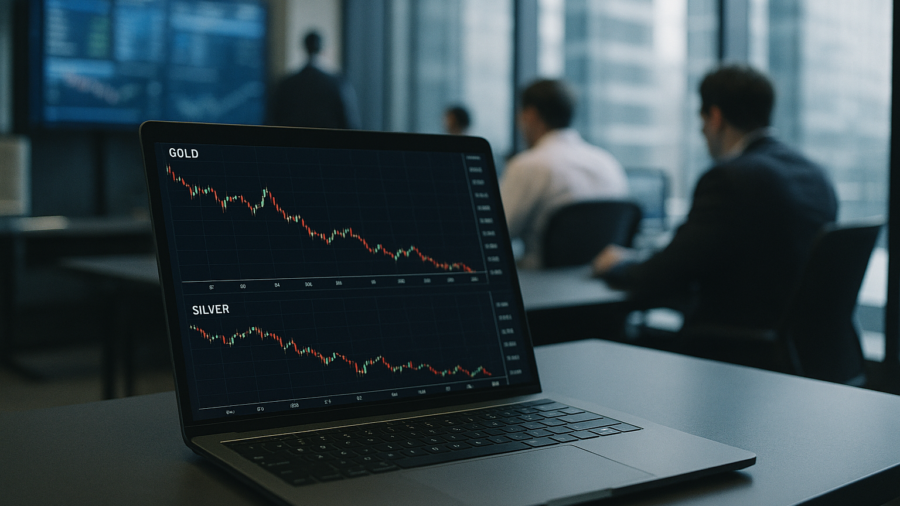
Gold and silver futures on the Comex division of the New York Mercantile Exchange settled lower on Wednesday, as investors trimmed positions in precious metals ahead of the Federal Reserve’s closely watched interest rate decision. The retreat reflected a broader pullback in safe-haven and inflation-hedge assets as market participants adopted a wait-and-see posture ahead of the central bank’s policy announcement.
According to the Wall Street Journal, gold futures for August delivery fell approximately 0.4 percent to settle near $2,330 per troy ounce on the Comex. Silver futures for July delivery also declined, slipping around 0.8 percent to settle near $29.40 per troy ounce. Both metals had traded near recent highs in prior sessions, making a modest pullback consistent with typical pre-event consolidation patterns seen across commodity markets.
Rate Decision Keeps Traders on Edge
The Federal Reserve’s rate-setting committee, the Federal Open Market Committee, was widely expected to hold the benchmark federal funds rate steady at its current target range during its meeting. However, traders were focused less on the immediate decision and more on the language accompanying it — specifically, any signals from Fed Chair Jerome Powell regarding the timing and pace of future rate cuts. Precious metals are particularly sensitive to interest rate expectations because higher rates increase the opportunity cost of holding non-yielding assets such as gold and silver.
The dollar strengthened modestly ahead of the Fed announcement, adding further pressure to dollar-denominated commodities. A firmer greenback makes gold and silver more expensive for buyers holding other currencies, dampening global demand at the margin. The ICE U.S. Dollar Index edged higher by roughly 0.2 percent on the session, compounding the headwinds facing metals traders already cautious about near-term direction.
Analysts noted that gold had demonstrated remarkable resilience over recent months, repeatedly testing and holding above the psychologically significant $2,300 per ounce level. Much of that strength has been attributed to persistent geopolitical uncertainty, sustained central bank buying — particularly from emerging market institutions — and lingering concerns about the trajectory of U.S. inflation. Those structural tailwinds remain intact even as short-term momentum fades.
Broader Market Context and Commodity Sector Dynamics
Wednesday’s decline placed gold on track for modest weekly losses heading into the Fed decision, though the metal remained well above its 50-day and 200-day moving averages — technical benchmarks closely followed by institutional traders. Silver, which carries a larger industrial demand component than gold due to its use in solar panels, electronics, and electric vehicle components, has at times this year tracked both precious metals sentiment and broader industrial commodity moves. Its sharper percentage drop on Wednesday reflected that dual sensitivity.
The energy and logistics sectors have also faced cost pressures with broader implications for inflation data that the Fed monitors closely. As The Fiscalist previously reported, two-speed inflation driven by tariff costs and residual price pressures continues to complicate the Fed’s calculus on when to begin easing policy — a dynamic that feeds directly into gold’s medium-term demand outlook.
Looking further ahead, commodity strategists broadly expect gold to remain well-supported above $2,300 per ounce through the second half of the year, with some projecting a test of $2,500 if the Fed pivots toward rate cuts by the fourth quarter. Silver’s industrial demand story, underpinned by the global energy transition, is seen as providing a longer-term floor even if near-term price action remains choppy. Investors tracking these trends may also find it useful to consider how AI energy costs are reshaping inflation expectations — a factor that could ultimately influence the pace of future Fed easing and, by extension, precious metals valuations.
For now, with the Fed’s rate path still uncertain and global growth signals mixed, gold and silver markets are likely to remain in a reactive mode, sensitive to every shift in policy tone from Washington and macroeconomic data from major economies.