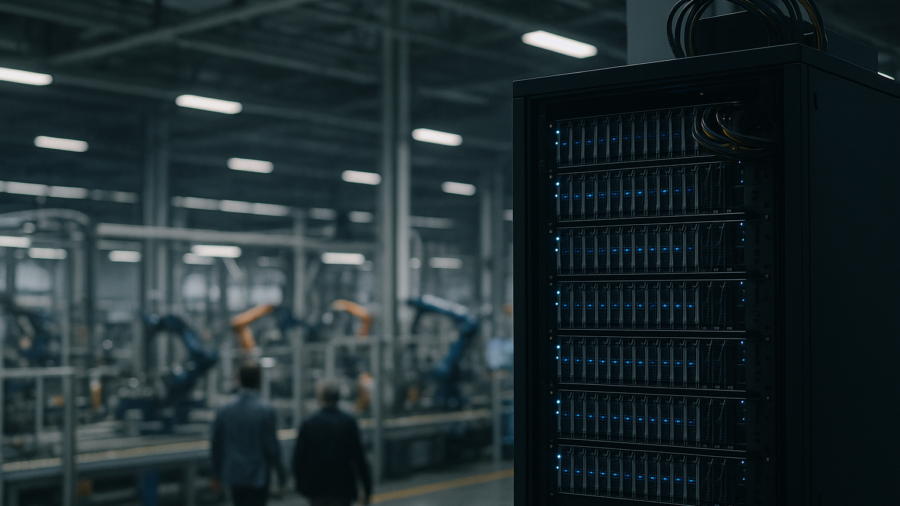
Artificial intelligence is doing something economists rarely see from a single technology: lifting prices and promising to lower them at the same time. The tension between AI’s near-term cost pressures and its longer-run deflationary potential has moved to the center of monetary policy debates, as central bankers and businesses try to determine which force will prove dominant — and when.
Marketplace reported on the dynamic in a segment titled “AI is pushing prices up, but it could slow inflation eventually,” published June 26, 2026, drawing attention to the dual-edged nature of the AI buildout now reshaping the American economy. According to that Marketplace report, the massive capital expenditure required to build out AI data centers, power grids, and semiconductor supply chains is feeding directly into elevated input costs across construction, energy, and advanced manufacturing.

Infrastructure Costs Create an Inflationary Surge in the Short Term
The scale of AI infrastructure investment is difficult to overstate. Major technology companies have collectively committed hundreds of billions of dollars to data center expansion, with power demand from these facilities emerging as one of the more persistent inflationary pressures in the current cycle. Electricity consumption from AI workloads is straining regional grids, pushing up utility costs for commercial and residential customers alike, and accelerating demand for natural gas as a bridging fuel.
Construction labor and specialized materials — copper wiring, cooling systems, high-grade concrete — have seen demand spikes directly attributable to the data center boom. Semiconductor fabrication plants, increasingly concentrated in the United States as part of a domestic supply chain push, add further pressure on skilled labor markets. These dynamics compound existing price stickiness in services, making the Federal Reserve’s task measurably harder. Cleveland Fed President Beth Hammack has directly addressed this concern; The Fiscalist previously examined how Hammack’s rate warnings signaled that AI-driven demand could justify additional monetary tightening if price pressures persist.
Financial markets have also shown sensitivity to the broader AI spending narrative. When concerns emerged earlier this year about competition from Chinese AI developers, equity markets sold off sharply on fears that investment returns from the AI buildout could disappoint — illustrating how intertwined AI capital flows have become with market stability. Asian equity markets have proven particularly reactive to shifts in AI sentiment, with the Kospi and Nikkei registering sharp single-session declines tied in part to global technology uncertainty, according to Press markets data.
The Long-Run Case for AI-Driven Disinflation
Despite the current cost surge, a growing body of economic analysis suggests AI could ultimately become a meaningful deflationary force. The mechanism is straightforward in theory: if AI tools raise productivity across enough sectors simultaneously, the economy can produce more output per unit of labor and capital, reducing the per-unit cost of goods and services. Historical analogies to earlier general-purpose technologies — electrification, the internet — suggest that such transitions are messy and inflationary upfront, but durably disinflationary once adoption reaches critical scale.
Sectors expected to benefit most include logistics, legal services, healthcare administration, and software development, where AI-assisted workflows are already demonstrating measurable efficiency gains. If these productivity improvements compound over several years, the result could be a structural downshift in services inflation, the category that has proven most resistant to the Fed’s rate-hiking cycle. The timing question remains unresolved. Most economists caution that the deflationary payoff is a mid-decade phenomenon at the earliest, meaning policymakers must navigate an awkward intermediate period in which AI-linked costs are real and present while the productivity dividend remains largely theoretical.
For investors, the divergence between today’s inflationary signal and tomorrow’s deflationary promise creates genuine positioning uncertainty. Monetary policy decisions in the next 12 to 18 months will likely reflect that ambiguity, with the Fed balancing evidence of AI-driven cost pressure against forward-looking models that assign meaningful weight to eventual efficiency gains. Readers tracking the broader monetary policy outlook may also want to follow The Fiscalist’s coverage of rate policy signals, where leadership changes and shifting frameworks could alter how AI’s inflationary and deflationary impulses are weighted in future decisions.