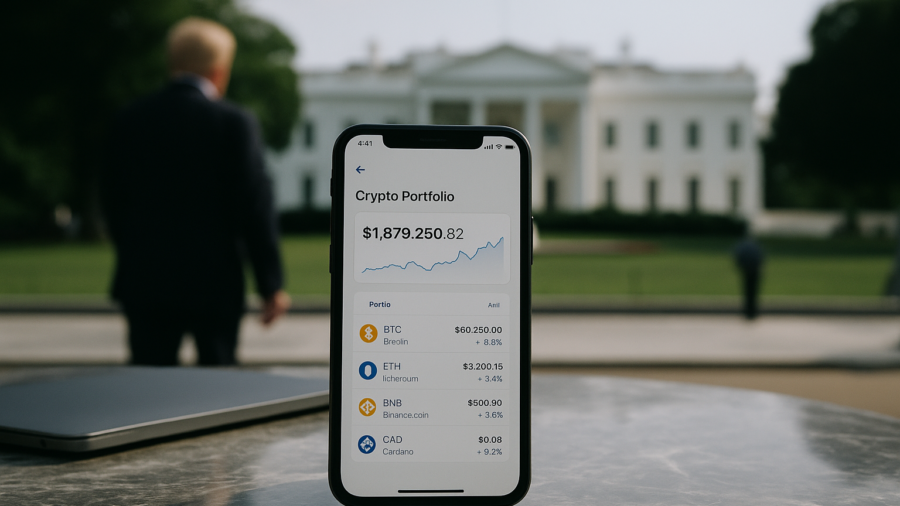
Donald Trump accumulated more than one billion dollars from cryptocurrency-related ventures during his first year back in the White House, according to a BBC News report published this week. The figure, drawn from financial disclosure documents and independent analyses, underscores the unprecedented scale of a sitting president’s direct financial exposure to digital asset markets — markets over which his own administration holds significant regulatory influence.
The disclosure has reignited debate among ethics lawyers, lawmakers, and financial watchdogs over the blurring of lines between personal enrichment and public policymaking at the highest levels of the United States government. Critics argue that no previous administration has presented a conflict of interest of this magnitude in the financial sector.

Meme Coins, Media Ventures, and a Digital Asset Empire
The bulk of Trump’s crypto-related income is reported to stem from the TRUMP and MELANIA meme coins, which were launched in the days immediately surrounding his January 2025 inauguration. The TRUMP meme coin alone surged to a market capitalisation exceeding $14 billion at its peak, with Trump-affiliated entities retaining a controlling share of the token supply. While valuations have since retreated sharply, early-stage sales and royalty-style fees generated hundreds of millions of dollars for entities linked to the Trump family.
Additional revenues flowed through World Liberty Financial, a decentralised finance platform backed by Trump and his sons, which raised more than $500 million from token sales to investors globally, including a significant proportion from overseas buyers — a fact that has drawn particular scrutiny from campaign finance and national security legal experts. Financial disclosure filings reviewed in connection with the Trump financial disclosures published earlier this year indicated the breadth of his expanding digital asset interests, which sit alongside traditional equity holdings including Apple stock.
Regulatory Overlap and the Conflict-of-Interest Question
The financial gains have arrived at a moment when the Trump administration is actively shaping the legislative and regulatory environment for digital assets. The White House has championed a series of pro-crypto executive actions, including an order directing federal agencies to develop a framework for a national strategic bitcoin reserve, and instructions to the Securities and Exchange Commission to ease enforcement actions against the crypto industry. Critics have described this policy direction as inseparable from the president’s personal financial interests.
Democratic lawmakers on the Senate Banking Committee have called for an independent investigation, arguing that the financial entanglements represent a textbook definition of self-dealing. Several Republican members have declined to endorse such an inquiry, though a small number have acknowledged the need for clearer ethical guardrails around presidential asset holdings. Legal scholars note that existing disclosure laws were not designed to anticipate a scenario in which a president is simultaneously a token issuer, platform backer, and chief regulator of an entire asset class.
The episode also carries broader market implications. When Trump has made public statements supportive of cryptocurrency — whether via executive order or social media — digital asset prices have responded sharply, a dynamic that financial analysts say creates an asymmetric information environment that disadvantages retail investors. As policymakers weigh the future architecture of crypto regulation, the question of who benefits most from those decisions has rarely felt more pointed. For readers tracking the institutional dimensions of this debate, the evolving conversation around Fed monetary policy offers important context on how regulatory uncertainty across asset classes is shaping the broader economic outlook heading into the second half of 2025.