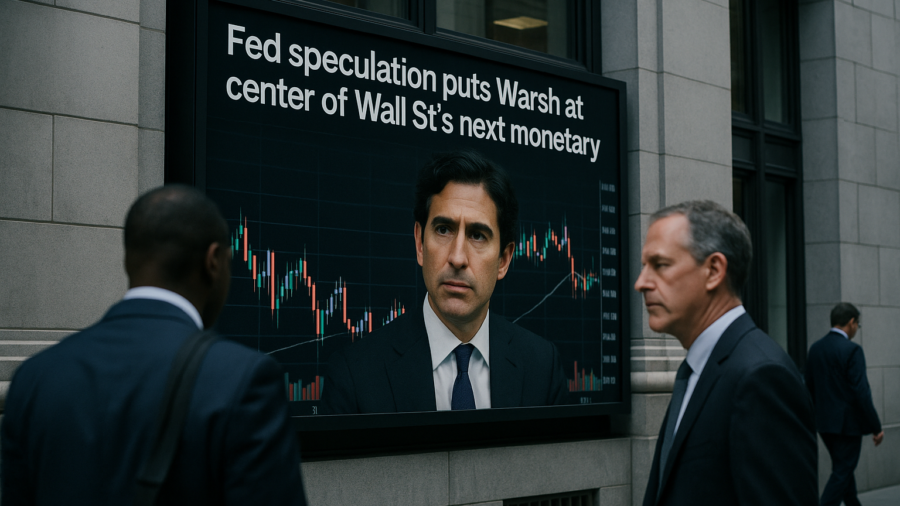
Wall Street strategists are increasingly factoring Federal Reserve succession into their market outlooks, and few voices carry more weight on the subject right now than veteran investor Bob Doll. In a recent commentary flagged by a MarketWatch report, Doll argued that equity bulls have benefited enormously from accommodative monetary conditions but warned that the bull case becomes considerably harder to sustain if Kevin Warsh takes the helm at the Federal Reserve and delivers the hawkish policy reset many expect from him.
Doll, chief investment officer at Crossmark Global Investments and a widely followed figure in institutional circles, told clients that the stock market’s resilience in 2025 and into 2026 has been built partly on the assumption that the Fed will remain relatively patient with rate cuts. Should Warsh, a former Fed governor and one of the leading candidates to succeed Jerome Powell, pivot toward tighter monetary policy or prioritize restoring the central bank’s credibility on inflation over near-term growth support, equity valuations could face meaningful pressure.
Why Warsh’s Monetary Philosophy Matters to Equity Markets
Warsh served on the Federal Reserve Board of Governors from 2006 to 2011 and has since been a vocal critic of what he characterizes as opaque central bank communication and excessive balance sheet expansion. His views are well documented: he has advocated for a rules-based approach to monetary policy, greater transparency in Fed decision-making, and a willingness to accept short-term economic pain in exchange for long-term price stability. For equity investors, that combination raises the stakes considerably.
Doll’s concern centers on the multiple expansion that has driven much of the S&P 500’s gains in recent years. The index has traded at elevated price-to-earnings ratios, with forward multiples hovering well above their long-run historical averages. In an environment where the Fed is willing to hold or cut rates, those valuations find a natural justification. A Warsh-led Fed that signals a higher-for-longer posture, or one that moves to unwind the balance sheet more aggressively, would effectively tighten financial conditions and challenge the earnings-growth assumptions currently embedded in stock prices. Our earlier coverage of Warsh’s monetary signals detailed how he has urged market participants to focus on economic fundamentals rather than relying on Fed guidance.
Markets in Motion as the Succession Question Looms
The broader market backdrop against which this debate is unfolding is itself noteworthy. Even as rate uncertainty lingers, equities have shown considerable resilience. According to Investopedia markets data from June 16, 2026, the Dow Jones Industrial Average hit a fresh record in the most recent session, buoyed by strength in select technology and aerospace names even as broader chip stocks faced some selling pressure. That kind of divergence underscores how sensitively markets are parsing sector-level risk as the macro picture shifts.

Doll’s message, however, is not one of outright pessimism. He stops well short of calling for a bear market. Rather, his argument is structural: the conditions that have rewarded equity bulls since late 2023 relied on a specific set of monetary assumptions, and any meaningful change in Fed leadership philosophy would require investors to recalibrate those assumptions carefully. He noted that a Warsh appointment could prove positive in the long run if it successfully anchors inflation expectations and restores institutional credibility to the Fed, but the transition period would likely be volatile and uncomfortable for risk assets.
The timing of the succession question is also relevant. Jerome Powell’s term as Fed chair runs through May 2026, and while White House officials have offered mixed signals about whether he would be reappointed or replaced early, Warsh has remained a prominent name in Washington discussions. Any official announcement on Fed leadership, whether confirming Powell’s continuation or naming a successor, could move markets sharply given how much the rate path debate has influenced asset allocation decisions across fixed income, equities, and currency markets alike. Investors who have been riding the bull run would do well, Doll implies, to keep one eye firmly on the Eccles Building. Readers tracking the broader investment risk landscape may also find useful context in our analysis of stretched market valuations heading into the second half of the year.