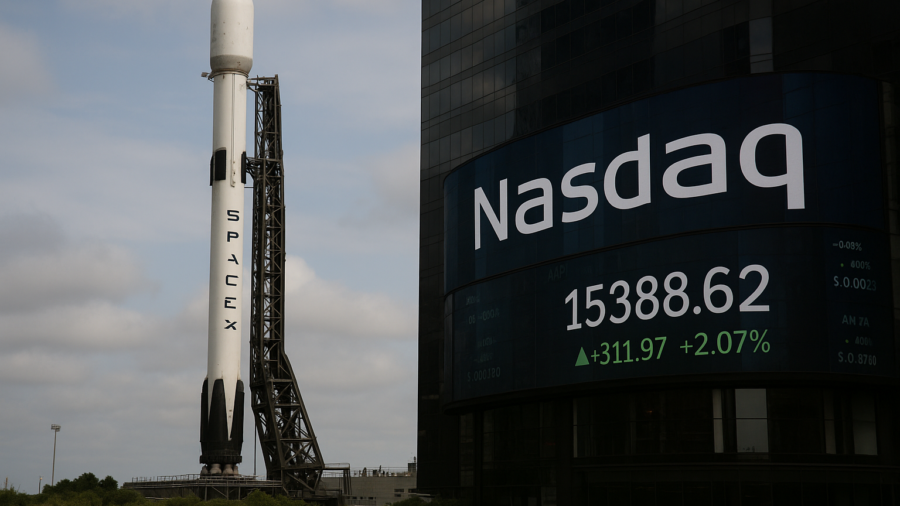
SpaceX, the privately held rocket and satellite company controlled by Elon Musk, is set to join the Nasdaq-100 index through an accelerated review process, a move that analysts say will generate billions of dollars in mandatory buying from exchange-traded funds and passive investment vehicles that track the benchmark. CNBC reported on the development on June 26, 2026, marking one of the most significant index inclusions in recent memory given the company’s unusual status as a high-profile private enterprise gaining entry to a major public benchmark.
The inclusion is expected to take effect within weeks rather than the standard quarterly review cycle, with Nasdaq opting for an off-cycle special rebalancing to accommodate SpaceX’s rapidly expanding market footprint. The company, which operates the Starlink satellite broadband network and holds dominant market share in commercial launch services, was most recently valued at approximately $350 billion in secondary market transactions, placing it comfortably within the top tier of Nasdaq-100 constituents by implied market capitalisation.

Passive Funds Face Forced Reallocation as Weighting Mechanics Kick In
The structural consequences of the addition are drawing intense scrutiny from portfolio managers and ETF strategists. The Invesco QQQ Trust, the largest ETF tracking the Nasdaq-100 with roughly $320 billion in assets under management, will be required to purchase SpaceX shares to match its new index weighting. Analysts at several major brokerages estimate that the total passive buying obligation across all Nasdaq-100-linked products could reach between $8 billion and $12 billion within the rebalancing window, depending on the precise weighting assigned to the company.
Because SpaceX remains technically private — accessing the index through a special share class structure similar to mechanisms used in past edge cases — the liquidity dynamics of the inclusion are being watched closely. Critics have raised concerns that the relatively thin float of tradeable SpaceX shares could amplify price volatility during the rebalancing period, as funds compete to acquire a fixed and limited pool of eligible securities. Index purists have also questioned whether the fast-tracked timeline bypasses the due diligence ordinarily applied to prospective members of the benchmark.
Retail investors with broad market exposure may also find themselves affected. As Forbes noted ahead of the official announcement, target-date funds and 401(k) plans with Nasdaq-100 exposure would gain indirect SpaceX positions automatically, without any active decision by the account holder. That dynamic is now playing out in real time as fund managers begin preliminary position-sizing calculations.

Strategic Implications for Index Composition and Competitor Stocks
SpaceX’s entry into the Nasdaq-100 will almost certainly displace one or more existing members, as the index is capped at 100 non-financial constituents. Nasdaq has not yet disclosed which company or companies will be removed to accommodate the addition, but analysts have speculated that lower-weight members in the semiconductor and biotechnology sub-sectors are most vulnerable. A removal announcement is expected to accompany the formal rebalancing notice, which index administrators are anticipated to publish within days.
The broader market reaction to the news has been mixed. While SpaceX’s own secondary market shares reportedly climbed sharply on confirmation of the inclusion, rival launch and satellite operators saw their valuations come under pressure as institutional investors recalibrated sector allocations. Rocket Lab, which competes directly with SpaceX in the small-launch market, was among the stocks drawing renewed attention from traders reassessing competitive dynamics in the commercial space sector. The Fiscalist previously covered significant premarket moves in Rocket Lab alongside other high-profile names as investor interest in the space economy has intensified in recent sessions.
For Musk, the Nasdaq-100 inclusion represents a landmark moment of institutional legitimacy for a company he has long insisted does not need public markets to fund its ambitions. Whether the move presages a formal initial public offering remains uncertain, but market participants will be watching closely for any signals that the index entry is part of a broader capital strategy rather than simply a structural milestone for passive investors.